
Why Humans Fail Each Other
Schopenhauer’s Dark Philosophy of Kindness, Betrayal, and Human Nature

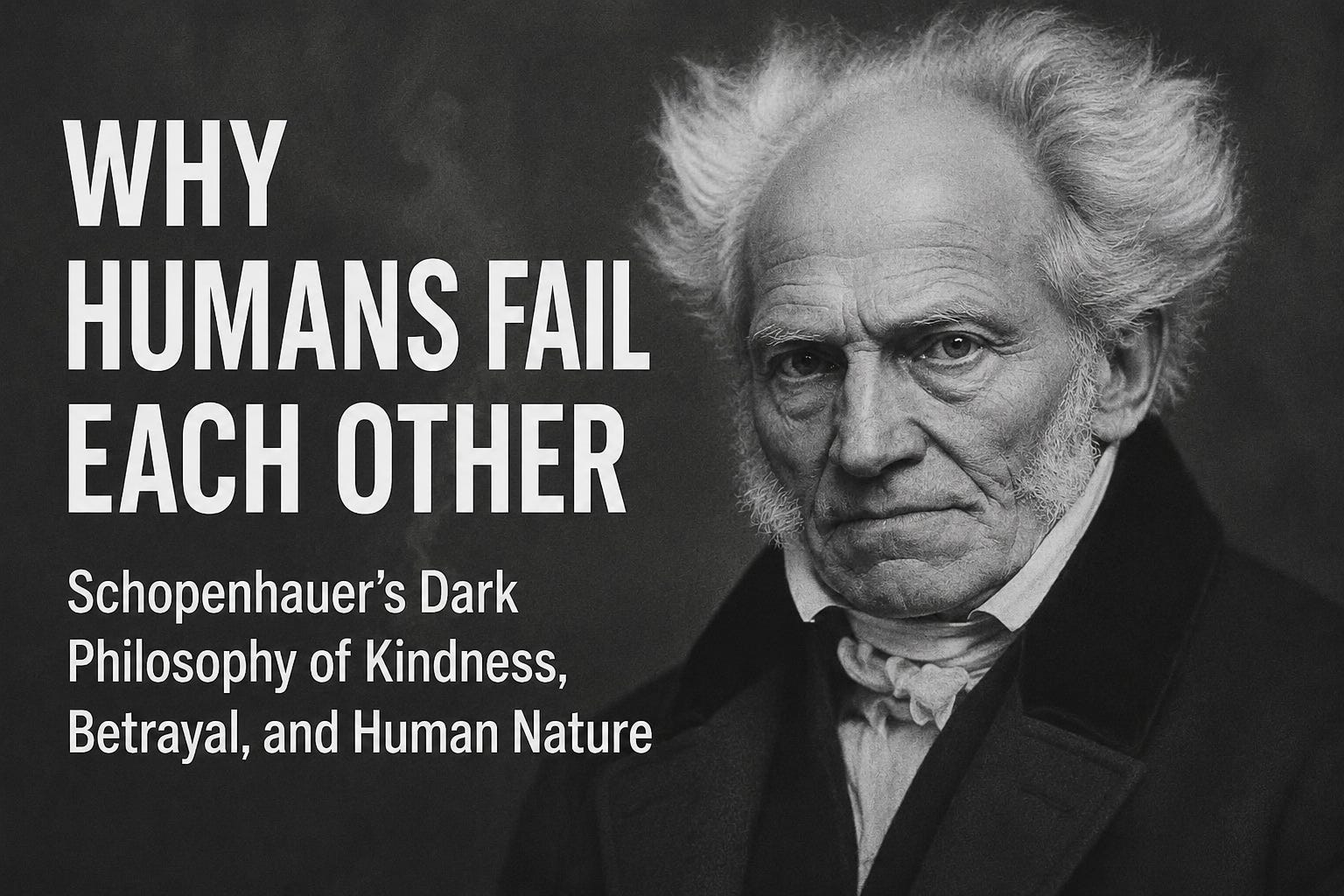
“Every man takes the limits of his own field of vision for the limits of the world.” ~ Arthur Schopenhauer
Almost everyone carries, in some quiet corner of their memory, the recollection of a person who seemed extraordinarily kind, always smiling, always available to listen, and who, the moment everything truly mattered, simply vanished, betrayed them, or revealed a different face beneath the one they had been wearing with such conviction throughout every previous encounter.
This isn’t a rare story. It’s perhaps one of the most common experiences of adult life, even though no one likes to admit it out loud at the dinner table.
Nearly two centuries ago, a German philosopher looked at this very phenomenon with an uncomfortable calm. And he quietly suggested that this isn’t the exception that confirms human goodness. It’s the silent rule that governs nearly every encounter between human beings.
In Danzig, in the year 1788, a boy was born who would be ignored by universities, left out of serious debate for decades, and treated as an uncomfortable voice that no one wanted to hear. And yet, he would still completely change the way Western thought would look at one uncomfortable question: Why do people, even the most smiley ones, so frequently fail one another?
His name was Arthur Schopenhauer. To some, a bitter and isolated philosopher; to others, one of the most lucid observers Germany has ever produced.
We’re going to look at him through one of the sharpest works he ever wrote, Aphorisms on the Wisdom of Life, which is part of the volume Parerga and Paralipomena. There, he says that there are always human gestures that look sweet and kind but lead to disaster, and others that seem cold or uncomfortable but offer protection and dignity for an entire lifetime.
Before we really set out on this path, one thing needs to be made clear. This is not an invitation to bitterness. It’s not a manual for you to start distrusting everyone on the street, at work, or in your own home.
Schopenhauer didn’t write to create paranoid people. He wrote to create lucid ones. And there’s an enormous difference between distrusting everyone and knowing how to choose better whom you trust. One is poison. The other is maturity.
What’s coming up may feel heavy at certain moments, and it’s only fair to warn you. But there’s a philosophical turn somewhere in the middle of the road that completely changes the meaning of everything that came before. Hang in there until then.
By the end, you won’t walk away colder. You’ll walk away more awake.
For more than a century, his philosophy was dismissed as sickly pessimism. It was described as poison for the youth. It was condemned by moralists who claimed that reading Schopenhauer would corrupt any optimistic spirit. According to his critics, he became the man who dared to say out loud what no one wanted to hear in the churches and parlors.
He wrote an entire system. It first appears in The World as Will and Representation, published in 1819. It’s then deepened in On the Basis of Morality from 1840.
This system is a journey through human nature, and it’s also an uncomfortable mirror for anyone who wants to understand how relationships between people actually work beneath their social masks.
Schopenhauer tries to show how the invisible game of kindness, smiles, and everyday pleasantries actually works in real practice. Today, we’re going to step into his pages to discover what he saw, what he named, and why so many people still prefer not to listen.
This newsletter is reader-supported. If you find value in my work, consider supporting me on Buy Me a Coffee and help keep this writing alive.
The Story Begins Before the Philosophy
Schopenhauer was born in Danzig, modern-day Gdańsk in Poland. But he spent most of his childhood in Hamburg, Germany, after the family moved there when he was five years old.
He came from a wealthy family. His father was a successful international merchant, the kind who saw his son as the natural continuation of his own business. From an early age, the boy carried on his shoulders an expectation that had been written before he was even born.
But he never wanted that life.
From childhood, he was drawn to books, to ideas, to abstract thought. And he had zero interest in the counter of commercial transactions that would dominate the life of a different kind of man.
On a long trip across Europe, taken with his parents to prepare him for the merchant’s career, the opposite of what was expected happened. Instead of falling in love with commerce, the boy saw up close the suffering and misery moving through European cities at the turn of the century.
Witnessing people’s pain so early on pushed him in the opposite direction of the destiny laid out for him. The more he saw how the world really worked, the more he wanted to understand, with the calm of a researcher, why it seemed to work so badly.
After breaking away from the family’s preset path, Schopenhauer enrolled at the University of Göttingen in 1809. By his third semester, he was captured by philosophy once and for all.
The following year, he transferred to the University of Berlin in search of more respected professors. There, however, he was disappointed once again.
The academic philosophy of that era seemed, in his eyes, needlessly complicated, distant from the real anguish of life, and almost always full of church doctrine hidden behind pretty words. Everything he despised was right there, sitting in the professor’s chair.
He didn’t put up with it for long.
He stepped away from the official intellectual circuit and spent the next decade philosophizing on his own. Reading Kant until he had taken him apart from the inside. Reading Plato like someone reuniting with a long-lost brother. Reading the Indian Upanishads when almost no one in the West even knew those texts existed outside of India.
By the age of 30, he had already published the work that would define his entire career.
That book was practically ignored at first. Hegel was the star of the moment. The German universities were applauding the official optimism of the era. And Schopenhauer sat in the corner of the intellectual room, waiting with the cold patience of someone who knows that time is the most honest judge there is.
“Time is the most honest judge there is.”
He was right.
Time proved his ideas correct. Today, when we read his description of human behavior, it feels like he was sitting next to us in some random café, watching the conversations around him with the attentive gaze of someone who lived outside the spotlight.
No marriage, no children, no students for long stretches of time, looking at humanity from a certain distance. And maybe it was precisely that distance that allowed him to see what those who are immersed in social relationships rarely manage to: what actually drives people in practice beneath the smiles.
The Will Beneath Human Kindness
The starting point of his philosophy is an idea that changes the world for anyone who understands it.
Behind all reality, he said, there is a blind, hungry force with no purpose other than to perpetuate itself. He called this force the Will, in German Wille.
It’s not the will that chooses between two flavors of ice cream on a quiet afternoon. It’s the Will with a capital W. The blind impulse that makes a plant grow toward the light without it knowing what light is. That makes the human heart beat even during the deepest sleep. That moves the stomach to demand food before reasoning can step in. That pushes the body to seek another body, the mind to seek status, security, revenge, pleasure, recognition, useful connection, social mirroring.
Before reason, before kindness, before consciousness, this brute force operates inside you.
And once we understand this, we start to grow suspicious of something important.
Every human kindness needs to be looked at carefully.
Because beneath it, almost always, there’s this underground hunger searching for something.
The blind impulse doesn’t think. It wants.
And when it uses pretty words, it’s only to get what it wants with less resistance from the world around it.
Think about any random moment of your day. The notification buzzing on your phone during family dinner, which you open before you’ve even finished the sentence you were saying to the person right in front of you. The blue light of the screen lighting up your face at eleven at night when you swore you were going to bed early. The message read but left unanswered for hours on purpose so the other person notices the silence.
All of this is the invisible engine running, calculating, maneuvering social position without your reason being entirely in charge.
Starting from this idea, everything begins to change in appearance for anyone who has learned to observe.
That wide smile in the office hallway takes on a different texture. The spontaneous compliment received on social media gains a suspicious weight when you notice it came from someone who had never shown interest before. The automatic friendliness of the coworker who just asked for a favor takes on different contours when the favor is denied and the smile vanishes in the same instant.
“The smile vanishes.”
It’s not that every act of kindness is fake. Schopenhauer didn’t say that in absolute terms either. He simply said that most of it is, and that confusing one for the other costs far too much to be treated lightly.
Being polite is one thing. Being good is something completely different.
The first is learned in just a few years of social interaction, by watching others, copying patterns, adjusting the way you speak. The second requires a change from the inside out that most people never make and never will, because that change hurts. And no one usually chooses, of their own free will, what hurts when they could choose what gets applause.
Learning this difference is one of the first steps toward reading the world as it really is, without the sweet filter we learn to apply to make things more bearable.
The Porcupine Parable
To illustrate how coexistence hurts, Schopenhauer wrote one of the most remembered parables in modern philosophy. It appears precisely in Parerga and Paralipomena.
Imagine a group of porcupines on a freezing German winter night. The cold bites to the point of pain, and they huddle close to one another to share the warmth of their bodies. But as they press together, their quills wound the skin of their neighbors.
In pain, they pull away immediately.
The cold returns, even crueler now, because the shared warmth had been tasted for a moment. They draw close again, more carefully. They wound each other again.
After many attempts, they find an intermediate distance, neither close enough to hurt nor far enough to freeze.
“After many attempts, they find an intermediate distance, neither close enough to hurt nor far enough to freeze.”
Schopenhauer said that life in human society is exactly that, and nothing more.
We are not a warm embrace by nature, even though we like to believe we are. We are pointy creatures trying to figure out, over the course of entire decades, just how much of one another we can stand without wounding each other and without freezing.
Help Sustains Existential Corner ☕ 🙏 👇

If these reflections resonated with your mind, consider supporting Existential Corner with a coffee, sustaining independent philosophical writing. ☕📖
If ONLY WE did not insist on telling ourselves that we do this. I worked in direct patient care > 50 years, l
There is a very dark underbelly to us. Our genes produce a very "not so nice brain."