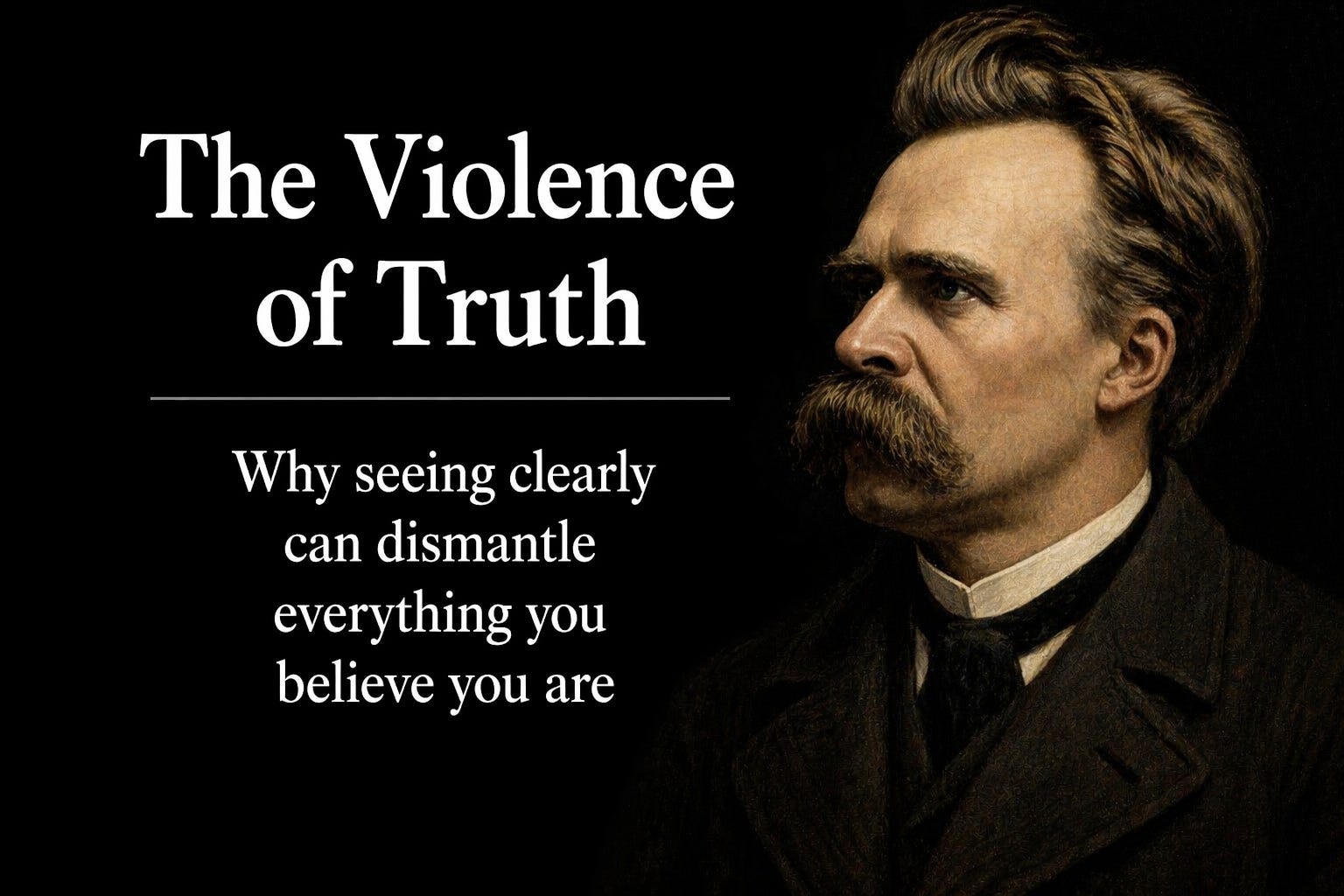
“Sometimes people don't want to hear the truth because they don't want their illusions destroyed.” ~ Fredrick Nitzesche
Imagine discovering that the very thing you believe defines your life… is a carefully constructed illusion. Imagine realizing that many of your opinions, your desires, even your identity… were not consciously chosen, but inherited, absorbed, and protected at all costs.
Now ask yourself… if the truth threatened all of that… would you really want to see it? Or would you resist it… without even knowing why?
There is a reason why truth feels uncomfortable. A reason why people turn away from it, reject it, or even attack those who speak it. And according to Friedrich Nietzsche, this resistance is not weakness alone… it is something far deeper—something embedded in the very structure of the human mind.
You will uncover why you instinctively resist the truth… why illusions often feel safer than reality… and how this hidden mechanism silently shapes your decisions, your relationships, and your entire perception of the world.
Nietzsche once suggested that humans are not seekers of truth… but seekers of comfort. This idea challenges everything we like to believe about ourselves. We tend to think that we are rational, that we value honesty, that we want clarity. But what if… beneath all of that… we are driven by something else? Something more primal—the need to preserve a stable sense of self.
Because truth—real truth—does not simply inform you. It disrupts you. It questions your beliefs. It exposes contradictions. It forces you to confront parts of yourself that you would rather ignore. And this is where the conflict begins.
Because the human mind is not designed for constant disruption. It is designed for stability. Psychologists like Leon Festinger described this through the concept of cognitive dissonance—the mental discomfort we feel when reality conflicts with our beliefs. And when this discomfort arises, we do not immediately seek truth… we seek relief.
We reinterpret facts. We deny evidence. We rationalize contradictions—not because we are stupid… but because we are protecting something fragile: our identity.
And this is what Nietzsche saw so clearly. He understood that many of our “truths” are not objective discoveries… but psychological constructions designed to make life bearable. Beliefs are not always chosen because they are true. They are chosen because they are useful—because they help us cope, because they allow us to function, and sometimes… because they prevent us from collapsing under the weight of reality.
So when truth appears—especially a truth that threatens your identity—it does not feel like enlightenment. It feels like danger. And your mind reacts accordingly. It resists. It defends. It rejects. Not consciously… but instinctively.
Think about a moment when you were confronted with something that challenged your worldview. Did you immediately accept it? Or did you feel tension… discomfort… maybe even irritation? That reaction is not random. It is a defense mechanism. And in many cases… it is so subtle that you do not even realize it is happening. You simply feel that something is “wrong” with the idea.
But what if… the discomfort is not a sign that the idea is false… but a sign that it is true? And more importantly… a sign that it is dangerous to the version of yourself you have built?
There is something unsettling about how the mind protects itself. It does not always reject the truth directly. Sometimes… it reshapes it—distorts it, softens it, or hides it behind layers of interpretation until it no longer threatens who you believe you are.
Nietzsche called this the creation of “necessary illusions.” Not lies in the obvious sense… but subtle distortions that make reality more tolerable. Because without them… life might feel too chaotic… too uncertain. So the mind creates meaning. It creates certainty. It creates stories that explain suffering, justify actions, and give structure to existence. And over time… those stories stop feeling like stories. They feel like truth.
Carl Jung later expanded on this idea, suggesting that much of what we believe to be conscious choice is actually influenced by unconscious patterns. In other words… you are not always thinking your thoughts. Sometimes… your thoughts are thinking you.
And when a truth emerges that contradicts those deep patterns… it does not feel like a simple disagreement. It feels like a threat to your psychological foundation. This is why people can defend beliefs even when presented with clear evidence against them. It is not about logic. It is about survival—at a psychological level.
The philosopher Arthur Schopenhauer, who deeply influenced Nietzsche, once said:
“a man can do what he wills, but he cannot will what he wills.”
Meaning… you may believe you are choosing your beliefs freely… but the underlying forces shaping those beliefs operate beyond your conscious awareness. And those forces have one primary objective: to maintain internal coherence—to keep your world consistent… even if that consistency is built on illusion.
Now consider this… what happens when truth threatens to break that coherence? The mind does not calmly analyze it. It reacts. It resists. It finds ways to discredit the source. It labels the idea as wrong, extreme, or irrelevant—not because it has been fully examined… but emotionally rejected.
If this essay resonates, consider supporting the Existential corner to keep ideas and stories alive.
Modern psychology confirms this through what is known as confirmation bias. We actively seek information that supports what we already believe… and we avoid, dismiss, or reinterpret information that challenges it. This is not a flaw of intelligence. Even highly intelligent people are subject to it. In fact… intelligence can make it worse.
Because the more intelligent you are… the better you become at justifying your illusions. You build more sophisticated arguments, more convincing narratives, more elegant defenses—all to protect something you may not even realize you are protecting.
So the question becomes… if your mind is constantly filtering reality… if it is shaping truth to fit your identity… how much of what you believe is real? And more importantly… how much of it are you willing to question?
Because the moment you begin to question your beliefs… you step into uncertainty. And uncertainty is something the human mind deeply fears. It prefers a comfortable lie over an uncomfortable truth. It prefers certainty—even if that certainty is false.
And this is where Nietzsche’s perspective becomes even more radical. He did not simply suggest that people avoid truth. He suggested that entire systems of belief—morality, religion, social norms—could be built not on truth… but on the need to avoid it.
He called this the “herd mentality.” The tendency of individuals to conform to collective beliefs—not because they are true… but because they are safe. Because standing outside the herd is dangerous. It exposes you. It isolates you. It forces you to think for yourself.
And thinking for yourself is one of the most difficult things a human being can do. Because it requires you to question everything you have been taught, to doubt what feels certain, and to face the possibility that much of what you believe… may not be real.
This is why truth can feel so heavy. It removes the comfort of certainty. It exposes contradictions in the world around you—and perhaps most painfully… it exposes contradictions within yourself.
Sigmund Freud revealed that much of our behavior is driven by unconscious desires and repressed impulses—things we prefer not to acknowledge, things that challenge the image we have of ourselves. And when truth touches these hidden parts… the reaction can be intense: denial, projection, anger.
Not because the truth is false… but because it is too revealing, too disruptive, too real.
So ask yourself… how often have you rejected an idea not because it was wrong… but because it made you uncomfortable? How often have you dismissed a perspective simply because it did not align with what you already believed? And more importantly… what truths might you be avoiding?
Because the deeper you go into this… the clearer it becomes. You do not always hate the truth because it is false. Sometimes… you hate it because it threatens to change you.
And here lies one of the most uncomfortable realizations of all—it is not just that you resist the truth. It is that… you are emotionally invested in not seeing it.
Because your beliefs are not just ideas. They are anchors. They give you a sense of direction. They tell you who you are. They tell you where you belong. And without them—even briefly—you can feel lost.
This is why truth is not simply a matter of knowledge. It is a matter of identity. To accept a difficult truth is not just to update your thinking… it is to transform the way you see yourself. And transformation—even when positive—feels like a kind of death.
The death of certainty. The death of familiarity. The death of a version of you that once felt real.
Nietzsche understood this deeply. He described the process of confronting truth as a kind of internal struggle—a battle between what you are… and what you could become. Because truth does not leave you unchanged. It demands something from you. It forces you to either evolve… or retreat back into illusion.
Modern neuroscience offers insight into this. Studies show that when deeply held beliefs are challenged, the brain can react as if it is facing a physical threat. The amygdala activates. Defensive responses increase. Rational processing decreases.
In other words… when your beliefs are attacked… your brain does not always seek truth. It seeks protection.
This explains why arguments rarely change people’s minds, why evidence alone is often not enough, and why debates turn emotional instead of logical. Because beneath the surface… it is not about being right. It is about feeling safe.
This safety is tied to your identity… to your sense of belonging… to your internal stability.
Now consider this carefully… if truth feels like a threat… and illusion feels like safety… which one do you think the mind will naturally choose?
This is the hidden mechanism Nietzsche pointed to—the reason why people can live entire lives within narratives… never fully questioning them. Not because they lack intelligence… but because they lack the willingness to endure the discomfort that truth requires.
And yet… there is a paradox here. Because while illusion may protect you in the short term… it also limits you. It keeps you within boundaries you did not consciously choose. It prevents you from seeing possibilities beyond what you already know. And over time… that limitation becomes a kind of invisible prison—comfortable, familiar, but restrictive.
So the real question is not simply why you hate the truth. The real question is… what is the cost of avoiding it? And is that cost something you are willing to continue paying?
At this point… something subtle begins to shift. Because once you recognize that your mind resists truth… you can no longer fully trust your first reaction to it. Discomfort is no longer a signal of falsehood. It becomes… a signal worth investigating.
And this changes everything. Because now, instead of asking, “Is this comfortable?” you begin to ask, “Why does this make me uncomfortable?” And that question… is the beginning of awareness.
Nietzsche believed that growth does not come from comfort. It comes from confrontation—from facing what disturbs you, from exploring what you instinctively avoid. Not blindly accepting every idea… but refusing to reject something simply because it challenges you.
This requires a different kind of strength—not physical, not even intellectual, but psychological courage. The ability to sit with uncertainty, to hold conflicting ideas in your mind without rushing to resolve them, to question yourself without immediately defending who you are.
Søren Kierkegaard spoke about this as the “anxiety of freedom”—the realization that you are not bound to your current beliefs, that you can choose differently, that you can redefine yourself. But with that freedom comes responsibility. And responsibility… can feel overwhelming.
Because if you are not who you thought you were… then who are you? And if your beliefs are not fixed… then what can you rely on?
This is the moment where many people turn back. They retreat into certainty… into familiar narratives… into identities that feel stable… even if they are limiting.
But those who continue—those who remain in that space of questioning—begin to experience something unexpected: clarity. Not the kind of clarity that comes from simple answers… but the kind that comes from deeper understanding.
They begin to see patterns, to recognize their own biases, to observe their reactions instead of being controlled by them. And slowly… they gain a form of freedom that is rarely discussed: the freedom from unconscious belief—the freedom to choose what to accept… and what to question.
This does not mean they become immune to illusion. No one is. But they become aware of it. And awareness changes the relationship.
Instead of being controlled by their beliefs… they begin to examine them. Instead of rejecting truth instinctively… they become curious about it—even when it is uncomfortable, even when it is disruptive.
So ask yourself something… when was the last time you truly questioned something you deeply believe? Not superficially… but seriously. Honestly. Without trying to defend it.
Because that moment—that willingness—may be the difference between living unconsciously… and beginning to see clearly.
And now… we arrive at the most important realization of all. The truth you avoid… is often the truth that has the power to transform you. Not because it is comfortable… but because it forces you to confront reality without filters.
Nietzsche did not see truth as something gentle. He saw it as something sharp—something that cuts through illusion, through identity, through everything that is false.
And when that happens… you are left with a choice. Not an abstract choice—a real one: to rebuild yourself based on what is real… or to retreat back into what feels safe.
This is why so many people spend their lives avoiding certain questions—questions about their purpose, their relationships, their beliefs, their fears. Because answering those questions honestly… requires change. And change… is unpredictable.
But here is the paradox—the more you avoid truth… the more your life becomes shaped by forces you do not understand: unexamined beliefs, unconscious patterns, inherited ideas. And over time… you begin to live not as someone who chooses… but as someone who reacts.
Reacting to circumstances. Reacting to emotions. Reacting to a reality you never fully questioned.
This is what Nietzsche warned about—not ignorance… but unconscious living. A life where you follow paths that were never truly yours. A life where your decisions are guided by invisible assumptions. A life where comfort replaces truth… and stability replaces growth.
But there is another path—a more difficult one. A path that requires you to face discomfort, to question yourself, to examine what you believe… and why you believe it.
And this path does not lead to easy answers. It leads to awareness. And awareness… is not always pleasant. But it is powerful.
Because once you become aware… you can no longer unknow what you have seen. You can no longer pretend that your beliefs are unquestionable. You can no longer live entirely on autopilot.
And this is where transformation begins—not in certainty… but in the willingness to see clearly.
So the next time you feel resistance to an idea… the next time something makes you uncomfortable… pause. Do not reject it immediately. Do not defend yourself automatically. Instead… ask: what if this discomfort is pointing me toward something I need to see?
What if the truth I am resisting… is the one I most need to face?
Because in the end… the question is not whether truth is easy. It is not. The question is… are you willing to see it… even when it changes everything?
Help Sustains Existential Corner 🙏☕ 👇
This newsletter is reader-supported. If you find value in my work, consider supporting me on Buy Me a Coffee and help keep this writing alive.



So 100% true.
Plato's Cave
Caveno body in the shadows wanted to know more
Very insightful.