
The Lie of Being Good
Why most kindness is driven by fear, not virtue

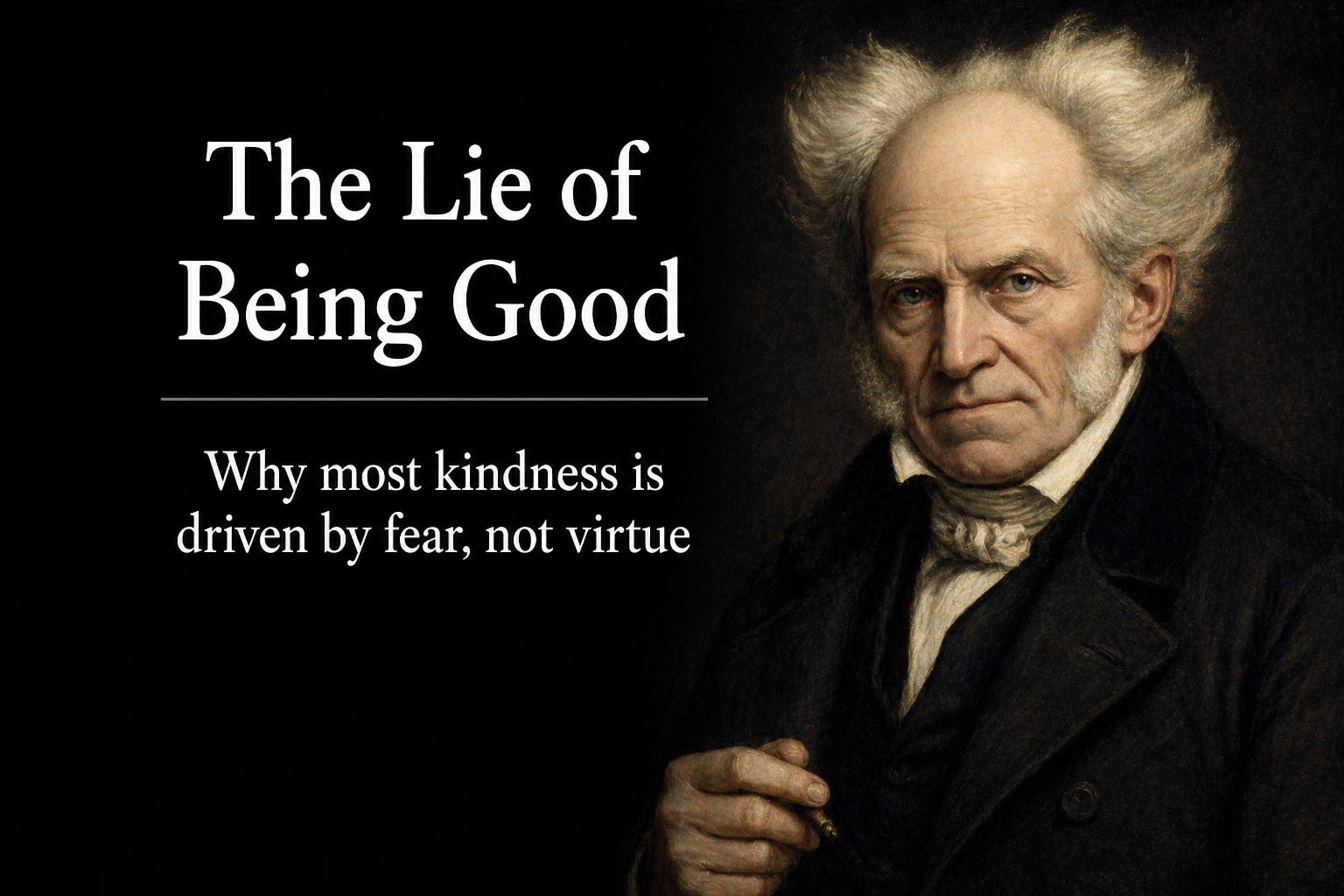
“Mostly it is loss which teaches us about the worth of things.” ~ Arthur Schopenhauer
Arthur Schopenhauer and the Illusion of Virtue
Arthur Schopenhauer isn’t just the philosopher known for his elegant pessimism. He’s the thinker who officially dismantled the Western idea of virtue in a single book. In 1840, the Royal Danish Society of Sciences was shaken by the essay he submitted for their contest on the foundation of morality. Instead of defending goodness as a sacred duty or a divine commandment, Schopenhauer did something unthinkable for his time he exposed what actually drives people when they think they’re being good: the fear of being rejected by the group, vanity disguised as virtue, and the silent calculation that poses as selfless affection.
It was one of the sharpest critiques ever made of the moral masquerade that holds modern societies together an intellectual rebellion that turned the concept of virtue upside down. He put his own reputation on the line, but the outcome was unexpected. And maybe the question Schopenhauer asked in that essay is the same one you need to ask yourself right now:
Why do you do good?
Answer honestly not out of habit, not based on what you’d like to be, but based on who you really are when no one is watching.
The Rejected Truth
The book he submitted was called On the Basis of Morality. It didn’t win the contest. The panel rejected the text, claiming he had treated the great philosophers of his era with disrespect. But what really bothered them was something deeper. Schopenhauer had spent years observing how people act when they think no one is watching and the conclusion he reached was deeply unsettling.
Over the decades, the text became foundational for anyone trying to understand why so many people seem good without actually being good. Most of what we call kindness doesn’t spring from genuine love or earned virtue. It emerges from social conditioning, from the ancient need to be accepted by a group that, deep down, isn’t good either it has simply learned how to appear so.
From the time we’re small, we’re taught to smile when we don’t want to, to back down when we should stand firm, to say yes when every fiber of our being screams no. After repeating this for decades, the line between genuine affection and performance dissolves. The mask fuses with the face.
False Kindness and Its Cost
Schopenhauer wasn’t saying this to make us cynical. He was trying to set us free. According to him, only someone who can see through their own false kindness has any chance of building something real. Maybe the turning point in your life begins not in what you do for others but in why you do it.
Think about that person everyone praises for their generosity the one who gave everything to others. Look closely. Is there still light in their eyes? Or is there exhaustion beneath the surface? A quiet resignation that was never spoken?
Schopenhauer argued that no life built on false kindness escapes its cost. The debt accumulates—in unexplained fatigue, in sudden resentment, in quiet moments where nothing distracts you from yourself. The body and mind both keep score.
Recognizing this isn’t judgment. It’s clarity. No one can sustain being someone they are not forever.
If this essay resonates, consider supporting the Existential corner to keep ideas and stories alive.
The Will and Hidden Motives
Inside us, Schopenhauer said, is something deeper than conscious intention a force he called the will. It’s blind, instinctive, and often drives what we believe are moral actions.
You help someone and feel relief but often that relief isn’t for them. It’s for you. Relief from guilt, from discomfort, from the fear of being seen as selfish. Most people never examine this internal mechanism. They act, give, comply and believe they are kind.
But beneath that “kindness” are deeper layers: fear of rejection, fear of abandonment, the childhood lesson that love must be earned.
“To be loved, you have to give yourself up.”
This belief installs itself quietly and begins shaping everything careers, relationships, family roles, even how we age.
By midlife, many arrive at a painful realization: they were never truly good they were afraid. And that fear, dressed as virtue, consumed years of their life.
Fawning: Kindness as Survival
Modern psychology calls this fawning a trauma response. The child who learns that conflict leads to punishment becomes agreeable, pleasing, invisible. That strategy may protect them early in life but it continues long after the danger is gone.
The adult becomes kind not by choice, but by reflex.
True Compassion: Mitleid
For Schopenhauer, real kindness had a name: Mitleid “suffering with.” Not pity. Not charity. But feeling another’s pain as your own.
He posed a question that still cuts sharply today:
“If no one ever knew about what you did, if there were no reward, no praise not even the silent satisfaction of considering yourself a good person would you still do what you did?”
Most people say yes quickly. But if you pause, the answer becomes less certain.
Pleasing is an investment.
Feeling is giving without expectation.
True compassion is rare because it requires the ego to step aside—and the ego rarely agrees.
Performative Kindness in Society
Schopenhauer observed that society rewards visible kindness and ignores invisible acts. The person who helps publicly is praised. The one who helps silently is overlooked.
Today, this dynamic is amplified. Kindness is shared, liked, documented. And the question becomes sharper:
How much generosity would survive absolute silence?
There is a form of kindness rooted in fear the fear of conflict, abandonment, invisibility. It looks like love, but it isn’t.
“Kindness driven by fear isn’t virtue. It’s a subtle and socially acceptable form of cowardice.”
The world applauds this person. But internally, something feels off. Exhaustion grows. Resentment builds quietly.
And eventually, it turns into something corrosive:
Bitterness.
Bitterness is the cost of being kind for the wrong reasons.
Despair and the Loss of Self
Søren Kierkegaard described something similar the despair of not being oneself. A life spent performing goodness can lead to deep emptiness.
A person may have everything family, career, respect and still feel they never lived their own life. They lived according to expectations.
That realization doesn’t arrive loudly. It falls like a silent avalanche.
The Invisible Audience
Schopenhauer noted that most people waste their lives worrying about what others think. Performative kindness is born here the desire to appear good becomes stronger than the desire to be good.
Life becomes a stage. Every action is for an invisible audience.
The tragedy? That audience doesn’t exist. It’s a mental construct we’ve carried since childhood.
The Ledger of False Kindness
There is an even more toxic form of kindness the kind that keeps score. Every act is recorded internally, with an expectation of return.
When that return doesn’t come, resentment follows:
“After everything I’ve done…”
Schopenhauer called this disguised selfishness. Not kindness, negotiation.
Real kindness ends in the act itself. No ledger. No debt. No expectation.
The Final Question
Recognizing all this is difficult but it’s also the beginning of freedom.
Because in the end, the question remains:
Who are you when no one is watching?
It’s in that silent space without applause or validation that your real ethics live. Your life is nothing more than the sum of those unseen choices.
Be good but first, be true.
Help Sustains Existential Corner ☕ 🙏 👇

This newsletter is reader-supported. If you find value in my work, consider supporting me on Buy Me a Coffee and help keep this writing alive.
I've never had anybody who caredvenough to remark one way or the other.