
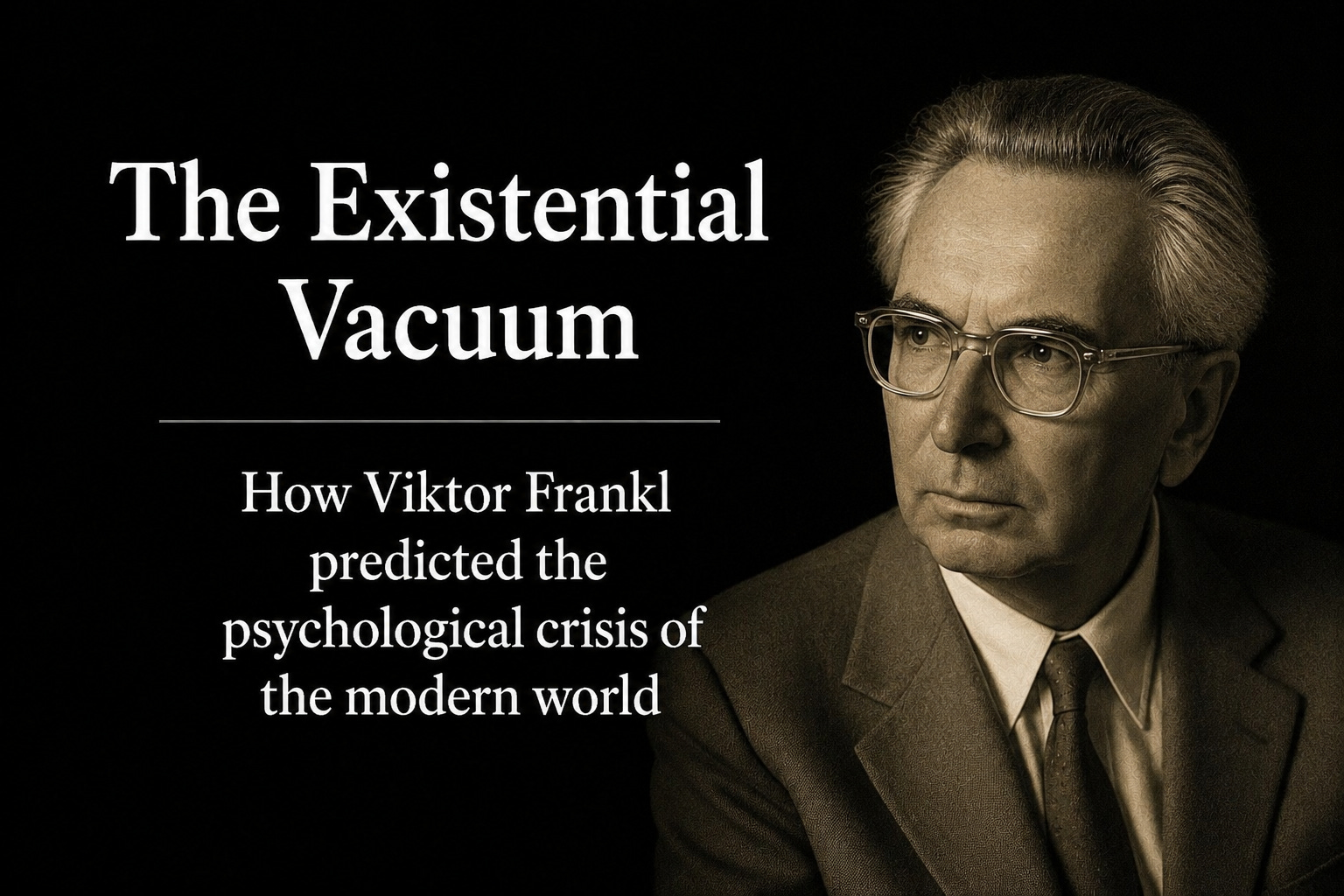
The Existential Vacuum
How Viktor Frankl predicted the psychological crisis of the modern world

“When we are no longer able to change a situation, we are challenged to change ourselves.” ~ Viktor E. Frankl
For a long time, I’ve been deeply troubled by that kind of life we live without even realizing we’re living it. That half-automatic routine: wake up, do the chores, reply to messages, fall asleep exhausted, and repeat the whole thing the next day.
That feeling pushed me into a somewhat reckless adventure, which was trying to understand why the modern world, even with so many good things going for it, still leaves people feeling so empty inside. And to dig into this, I picked up the book Man’s Search for Meaning by Viktor Frankl.
What I found in there was a pretty heavy diagnosis, showing that this exhaustion you feel today isn’t your fault. It was the symptom of a prediction made 60 years ago by a psychiatrist, one that has been gradually confirming itself all over the world.
What he discovered explains exactly why you’ve been feeling so empty, even when, on paper, everything seems to be in order.
Frankl had a bold intellectual plan, one that was almost impossible to pull off. He wanted to discover what he called the main engine of the human being. But this wasn’t some lab theory, nor a pretty idea written up in a fancy office. He wanted something that could be tested under the worst conditions a human being has ever lived through.
Viktor Emil Frankl was born in Vienna in 1905, and in 1942 he was deported to the Theresienstadt ghetto and, two years later, transferred to other captivity camps in Central Europe during the Second World War.
He never had the chance to study people in a controlled environment. He didn’t test his ideas in a university research project. Observing people in extreme situations is, for most psychiatrists, a side pursuit, something you do at the tail end of your career. For him, it was his entire life for three years.
He was forced to see the worst of humanity up close, the same way we’re forced to see the traffic in the city where we live.
Before he was 20, Viktor Emil Frankl was already exchanging letters with Sigmund Freud. Before he was 25, he had already broken away from Adler’s circle for defending an idea that neither of the two great schools of psychotherapy in Europe accepted.
He studied psychiatry and neurology at the University of Vienna, and during the 1930s he began developing an idea that was heretical to the psychoanalytic tradition of the time: the idea that human beings aren’t primarily driven by pleasure, as Freud claimed, nor by the will to power, as Alfred Adler claimed, but by something more fundamental, more silent, more difficult to measure — the search for meaning in their own existence.
This newsletter is a solitary effort of thought and writing. If it resonates, consider offering a coffee in support. ☕
In 1942, his life collapsed.
He was deported with his wife, his parents, and his brother Walter to the Theresienstadt ghetto. In 1944, two years later, he was transferred to other camps within the same system under increasingly worse conditions.
He lost his father, his mother, and his brother within a short span of months. His wife, Tilly Grosser, whom he had married shortly before the deportation, was pregnant. They were prevented from carrying the pregnancy to term by order of the totalitarian regime of the time.
Tilly died shortly after of typhus at just 24 years old.
When Frankl was liberated in 1945, he was 40 years old, with no close family alive, no manuscript of the book he had started, and no certainty about what to do with the rest of the life he had left.
At 40, with no one, with nothing, starting over from scratch, he did something that’s still impressive today. In nine days, he dictated to three secretaries the book that would become one of the most important works of the 20th century.
Published in German in 1946 and known in English as Man’s Search for Meaning, the book — which he initially wanted to release anonymously because he didn’t think it deserved attention — sold more than 16 million copies and was translated into more than 50 languages.
In 1991, a survey conducted by the Library of Congress in partnership with the Book of the Month Club listed it as one of the ten books that most influenced the lives of Americans.
For a work written in nine days by a man who had just lost everything, that’s an almost impossible statistic.
Why Frankl’s Authority Matters
This authority is the first thing that needs to be made clear. He’s not some armchair theorist who wrote about suffering after sipping tea in Geneva. He’s a man who tested every single one of his ideas under the worst conditions ever faced by a human being.
When he claims there’s an irreducible space of choice within any person, he’s talking about something he saw with his own eyes: inside the barbed wire, in the mud, in the cold, in the hunger, with the smell of death hanging over him.
It’s not a metaphor. It’s direct observation made with a clinical eye, mentally noted because pencil and paper had been confiscated.
And what he saw while watching his fellow prisoners was this: the ones who held on weren’t the strongest physically, nor the healthiest, nor the youngest. The ones who held on were the ones who had a reason to hold on.
Someone waiting on the outside. An unfinished book. A promise to keep. A mission still ahead.
In one of the passages of Man’s Search for Meaning, he tells how he would mentally reconstruct, while standing in the snow, the lost manuscript line by line, chapter by chapter. He knew that if he made it back, he’d come back with that.
And he came back in every sense of the word.
In several moments throughout the book, a quote from Friedrich Nietzsche appears that seems to have been written to describe exactly what he observed:
“He who has a why to live can bear almost any how.”
It’s not a motivational quote to slap on a coffee mug. It’s a clinical observation made by a psychiatrist inside a place where more than 90% of the prisoners didn’t come back.
The central thesis became simple and devastating: human beings can endure almost anything, as long as that anything has some meaning.
When meaning fails, even comfort turns into torture.
And that’s exactly what’s happening right now on a massive scale to most people.
The Existential Vacuum
The concept that comes next gives a name to what you’re probably feeling at this moment, even without having the words to define it.
In another foundational book, The Will to Meaning, built from lectures given in the 1960s in the United States, the psychiatrist presented a diagnosis that seemed exaggerated at the time and that today reads like a literal description of the world.
He called the phenomenon the “existential vacuum.”
The phrase in German is existentielles Vakuum, and it describes a very specific feeling: the feeling of a person who has everything they were supposed to have, who has fulfilled the script they were handed, who has a house, a job, relationships that look fine on the surface, and yet still feels a deep boredom, an indifference, an impression of running on a treadmill that’s not going anywhere.
It’s the hollow that no calendar can fill.
In his Viennese practice after the war, he treated thousands of patients in private practice and at the General Polyclinic Hospital in Vienna, where he directed the neurology department from 1946 to 1971.
And he started noticing a strange pattern.
The patients with the hardest symptoms to treat weren’t the poor or the terminally ill. They were the successful ones: doctors at the peak of their careers, executives with packed schedules, housewives in upscale neighborhoods, young heirs without a single material need.
People who, according to any happiness manual of the time, should have been doing fine — but weren’t.
They felt hollow.
Some of them spoke of dark thoughts without understanding where they came from. Others sank into addictions for no apparent reason. Others simply stopped caring about anything, in a slow shutdown of themselves.
The clinical observation was of a new neurosis, one that didn’t fit into the classical diagnosis.
The name he gave it was “noogenic neurosis,” that is, an illness born not from the conflict between repressed desires, as Freud would say, nor from the struggle for self-overcoming, as Adler would say, but from the absence of meaning in one’s own existence.
This category, instead of becoming an academic curiosity, exploded across the world.
Today, it is, under various other names, the backdrop of most of the complaints that walk into therapy offices.
The existential vacuum would become the number one illness of the developed world.
As society solved the problems of basic survival, a problem of another order would surge in with full force: the problem of meaning.
People with full stomachs and a roof over their heads would discover that this wasn’t enough, and they wouldn’t know what to do with that discovery.
The era with the most comfort, the most options, the most technology, and the most discourse about happiness is also the era most sick on the inside.
The number one illness today in the developed West isn’t hunger. It isn’t lack of information. It’s the lack of a reason.
And no one teaches this.
School doesn’t teach it. College doesn’t teach it. The work environment rewards the very behaviors that deepen the problem. And social media algorithms keep the person occupied just enough that they never get to see what’s actually happening in their own life.
The Trap of Chasing Happiness
There’s a specific trap in this culture, and it’s been described with precision: the trap of treating happiness as a target.
The logic seems obvious and is everywhere:
If I want to be happy, I need to chase happiness, optimize life for it, choose decisions that increase it.
Apps, books, ads, and influencers all promise this.
And yet, the more someone pursues happiness directly, the more it slips away.
There’s a body of research in positive psychology conducted by names like Iris Mauss at the University of California, Berkeley, that confirms what Frankl was already saying clinically back in the 1950s.
People who value happiness as a direct and explicit goal report, on average, higher levels of sadness and more depressive symptoms — not by chance, but by design.
The technical name for this phenomenon, in works like The Doctor and the Soul, is “hyper-intention.”
Whoever hyper-intends sleep doesn’t sleep. Whoever hyper-intends performance fails. Whoever hyper-intends to be happy gets depressed.
Happiness is a side effect. It’s not a target.
It’s the consequence of a life with direction.
You don’t reach it by aiming at it. You reach it by aiming at something else, and it shows up off to the side, unnoticed, while you’re busy with what matters.
Help Sustains Existential Corner ☕🙏👇

This newsletter is reader-supported. If you find value in my work, consider supporting me on Buy Me a Coffee and help keep this writing alive.
Thank you for this. I've been diving into Dr Frankl's life and work and find it is ever more pertinent.
Yes, he believed that hope was a dangerous thing as when more positive circumstances fail to emerge it does not lift one up but actually smashes him fully into the ground. That which is requisite for any man irrespective of how favorable or unfavorable his circumstances are is a belief that his struggles if not outright suffering has meaning. It does upend this favorable idea of hope that we are usually fed in society. https://oddballmagazine.com/essay-by-steven-david-justin-sills-26/