
The Death of Simplicity
Dostoevsky and the Modern Fear of Being Genuine

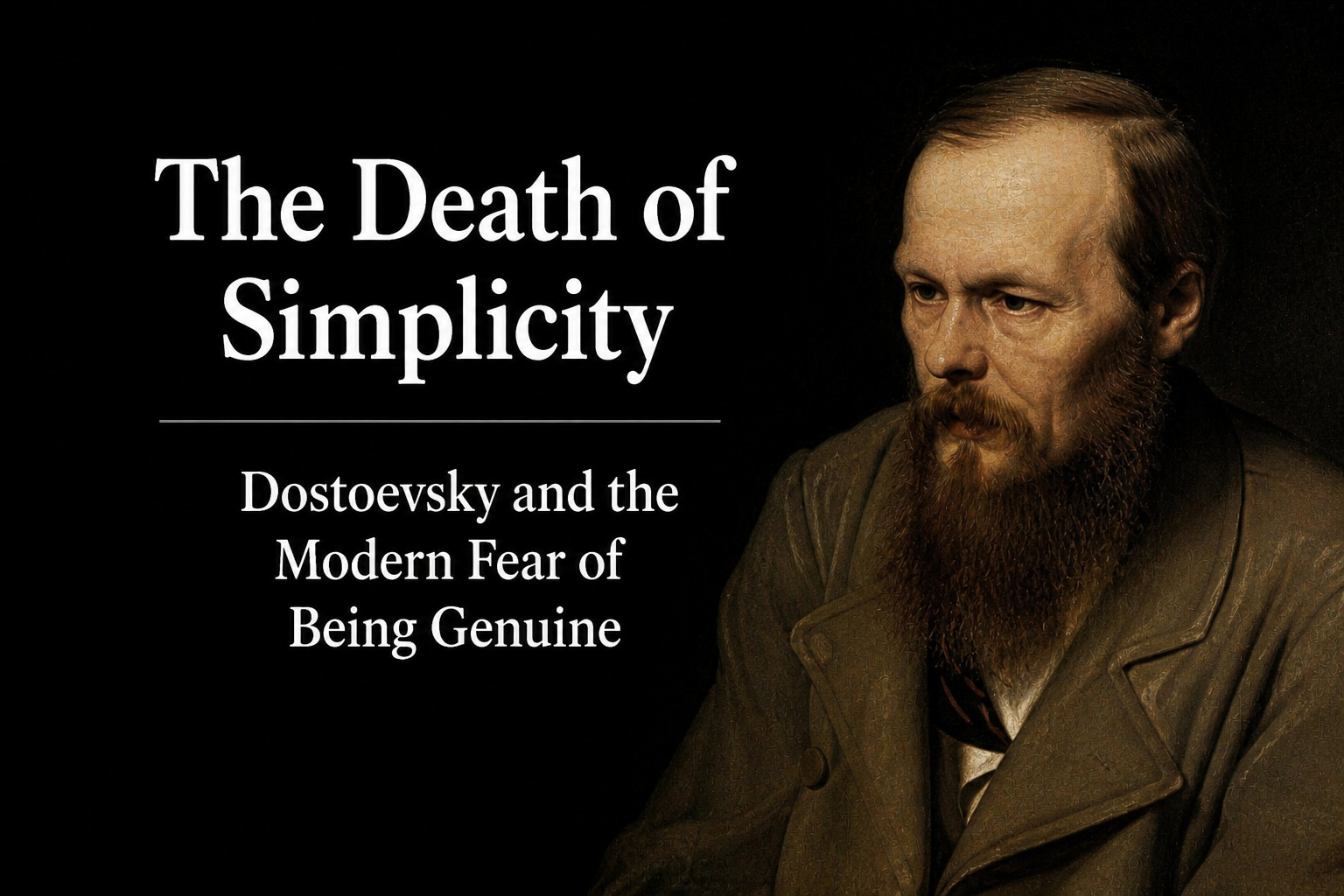
“Sometimes the simplest man sees the truth more clearly than the cleverest mind.”~ Fydor Dostoevsky
“You’re not broken. You’re not doing anything wrong. You’re not an idiot for feeling tired of pretending all the time. You are perhaps right in the middle of a process that nobody warned you was going to begin — a silent process, one that’s going to make you look at people you always thought were naive and start questioning the judgment you yourself made of them.”
There’s a specific person somewhere in your life. It could be a grandmother, a quirky coworker, a quiet neighbor, someone you laughed at lightly in recent years. Someone who trusts too much, who forgives too quickly, who helps without asking for anything in return. You always thought they were kind of foolish.
But there are days, usually when exhaustion hits, when you catch yourself thinking that maybe they’re living better than you are. That bothers you.
And that’s where this begins.
What you’re about to hear may be uncomfortable. And maybe you really need it.
Fyodor Dostoevsky.
Maybe you’ve never heard of him. Or maybe you’ve seen the name on the cover of some thick book. But the ideas that are going to come up here don’t require any reading résumé. They ask for only one thing: honesty when looking at yourself in the mirror.
Because everything he wrote talks about one single thing, and that thing doesn’t need a diploma to be understood.
For those who’ve never read a single line, what follows will work like a conversation. For those who have read him, it’ll work like a rereading. Both end up in the same place.
Before explaining what this man saw, you need to understand where he was speaking from.
Dostoevsky was born in Moscow in 1821, the son of a strict military doctor and a sickly mother who died young. While still a young man, he joined a group of intellectuals who debated social reforms in a country ruled by an authoritarian czar. He was reported, arrested, and sentenced to death.
On a winter morning, he was led out to an execution courtyard, blindfolded, and placed in front of a firing squad. At the very last moment before the shot, an officer arrived on horseback bringing the commutation of his sentence. The execution was staged.
The whole thing had been a piece of psychological theater put on by the regime. But the fear, the farewell to his own life, the physical sensation of death — that part was real.
“At 28, Dostoevsky died inside and came back.”
After that, he was sent to a prison in Siberia where he spent years surrounded by murderers, thieves, and desperate men. He came out a different man.
Later in life, he would lose a small child, bury his first wife, and live hounded by debts and by epileptic seizures that knocked him to the floor without warning.
He wasn’t an armchair philosopher. He was someone who knew suffering from the inside, on a set schedule, with a baptismal name, with an address.
And it was precisely because of that torn-up biography that he managed to see, before almost anyone else, a silent disease that was beginning to spread through 19th-century Europe. A disease without a virus, without fever, without coughing. A disease made of an oversized head and a tightened heart.
A disease that, two centuries later, hit its peak inside your apartment, inside your car, inside your phone.
If this essay resonates, consider supporting the Existential corner to keep ideas and stories alive.
Dostoevsky’s Central Thesis
“Modern man is a sick person who thinks he’s healthy.”
We think we’re smarter than our grandparents, more informed, freer, more connected. And in a sense, we are.
The problem is that along with all this intelligence came an anxiety no previous generation had known at this intensity. A strange loneliness even in the middle of a crowd. An emptiness that shows up when the phone shuts off, when the noise stops, when the distraction ends.
Anxiety disorder rates among young adults break records year after year. People’s trust in one another has collapsed in nearly every developed country. Self-reported happiness among teenagers plummeted right around the moment the smartphone became a part of the body.
We’re not imagining things.
There’s a real malaise spread out in the air.
And the central symptom of this sickness, according to Dostoevsky, has a very specific shape.
“It’s the hypertrophy of consciousness.”
“It’s thinking too much and feeling too little.”
It’s analyzing everything, predicting everything, calculating everything, and losing along the way the ability to simply live.
In 1864, he published a short, strange book narrated in the first person by a nameless man. The text is called Notes from Underground.
The narrator lives alone in a damp basement in St. Petersburg, writes for nobody, talks to an imaginary listener, and spends entire pages humiliating himself, bragging about himself, contradicting himself.
He’s intelligent. He notices everything.
Every gesture of his own, every gesture of others, every microexpression at a dinner party, every small slip in a conversation — all of it is decoded by him in real time.
And precisely because of that, he becomes incapable of anything important.
He can’t love. He freezes up before acting. And he loses the ability to simply be happy in a single moment without reviewing it a thousand times.
“Consciousness, taken to the extreme, paralyzes.”
The Underground Man is a warning. An advanced portrait of a figure who is common today.
You probably know someone like that. Someone who knows everything, reads everything, comments on everything, and yet seems trapped inside their own head, unable to take a single real step in any direction.
It might be a friend. It might be a colleague. It might be, on certain bad days, yourself in the bathroom mirror before going to bed, rehearsing a conversation that isn’t going to happen the next day.
The Infinite Mirror
This character embodies the first inversion that Dostoevsky wants to call out.
“The modern world thought that more consciousness would bring more life. It brought the opposite.”
It brought life cast in plaster inside an infinite mirror where every movement has to be reviewed, justified, optimized, compared.
Social media has cranked this up to a level he couldn’t even have imagined.
You post a photo and sit there watching the like count. You send a message and wait for the seen notification. You set up a coffee date, and you’re already planning how you’re going to come across at the coffee date.
“Consciousness, instead of serving life, has turned into a cage.”
And worse than that, a cage with cameras on every side.
Stop and think for a moment about what screens are doing to people’s inner lives.
We’re losing the ability to be alone without a distraction. We’re losing the ability to pay full attention to a single face during a conversation. We’re losing the ability to be bored.
“And boredom is the gateway to real imagination.”
Kids today reach for the phone before a thought even has time to form. Adults do the same thing in elevators, in lines, in waiting rooms, in bathrooms.
Every micro-interval of life has been filled in.
And inside that filling in, the digital Underground Man was born. A resident of a closed-off room, even when the room is a packed subway car.
The Cult of Cleverness
Along with that hypertrophy of the head came another inversion — maybe even more dangerous:
“The cult of cleverness.”
“The silent contempt for goodness.”
Stop and listen to the vocabulary used in adult conversations today.
Whoever trusts is a sucker.
Whoever forgives is weak.
Whoever helps without charging is a fool.
Whoever’s honest when they could have lied is unprepared for the world.
Whoever shows emotion in public is being dramatic.
The cold person is admired.
The calculating person is respected.
The ironic person is applauded.
And whoever insists on being good, with no air quotes around it, gets pushed into a corner like an endangered species.
Dostoevsky watched that inversion start to take root in the Europe of his time under the influence of philosophical currents that promised to free man from the old morality in exchange for a new kind of rationality — cold and efficient.
He realized, before almost anyone else, that this trade wouldn’t make human beings any happier.
“It would make them lonelier, more resentful, more incapable of any sincere gesture.”
Because the cynic, deep down, is someone who has protected his heart with so many layers of armor that he has forgotten how to take the armor off when it’s time to receive affection.
There’s an important detail here.
“Cynicism sells itself as intelligence, but technically it’s the opposite.”
People with high levels of cynicism — meaning a generalized distrust of other people’s motives — tend to have lower lifetime income, lower professional success, and worse mental health indicators when compared to more trusting people.
The cynic thinks he’s the smartest one in the room.
“In the end, he’s usually the biggest loser in the room, just with a good vocabulary to hide it.”
And even so, the cynical aesthetic continues to dominate.
Movies. TV shows. Comedians. Social media accounts.
Everything rewards the sharp, ironic, sarcastic, slightly cruel tone.
The good character is boring.
The traitor is fascinating.
This cultural preference is not innocent.
“Drop by drop, generation after generation, it teaches us that an open heart is corny and that a closed heart is cool.”
Dostoevsky would be barely surprised.
The phenomenon he described didn’t invent anything new.
It just modernized itself.
The Idiot
And here we get to the book that gives this reflection its name.
In 1869, Dostoevsky published The Idiot.
The title is a provocation.
The main character’s name is Prince Lev Nikolayevich Myshkin. He’s just returned to St. Petersburg after years in a Swiss sanatorium where he was being treated for a form of epilepsy.
He’s gentle, honest, incapable of lying, incapable of holding grudges, incapable of playing social games.
When he enters Russian high society, everyone senses something strange in his presence.
The women are intrigued.
The men are irritated.
The sharp tongues start passing around the same verdict behind his back:
“He’s an idiot.”
But the reader, page after page, notices that something doesn’t add up.
This idiot sees what nobody wants to see.
He sees the hypocrisy of the ladies who smile out of self-interest.
He sees the humiliation of the disgraced young woman whom everybody looks at with fake pity.
He sees the despair behind the cheerful manner of a bankrupt general.
And he doesn’t use any of it as a weapon.
“He just sees and goes on being good.”
The shock running through the whole book is this:
“He isn’t a fool.”
“He’s the only one truly clear-headed in an environment rotting away behind appearances.”
He’s an idiot only in the mouths of others.
Why does the world need to bring down a person like this?
Why does it need to slap a label of inferiority on them?
Here we run into one of the harshest perceptions the Russian author ever had.
“When someone lives without a mask, without calculation, without ulterior motives, they become an unbearable mirror.”
Being near that person means being forced against your will to look at your own dishonesty.
And almost nobody can stand that look.
So the collective way out is to root for him to be dumb, to root for him to be naive, to root for him to be out of touch with reality.
Because if he’s only that, we can keep going as we are.
But if he’s actually seeing something legitimate, then we’re the ones with the defect.
And nobody wants to admit that at a Sunday dinner.
Dostoevsky’s character suffers not because he gets things wrong.
“He suffers because he gets things too right.”
He suffers because his truth is too big for a world that has gotten used to living off small, mutually agreed-upon lies.
This is the heart of the inversion.
“The label idiot is very often the silent indictment of a sick environment.”
And the one who applies it is almost always confessing something about himself without realizing it.
Help Sustains Existential Corner ☕ 🙏 👇

This newsletter is reader-supported. If you find value in my work, consider supporting me on Buy Me a Coffee and help keep this writing alive.
This is, perhaps, the best article I've ever read about F.D.
Thank you, from a devoted observer of his art.